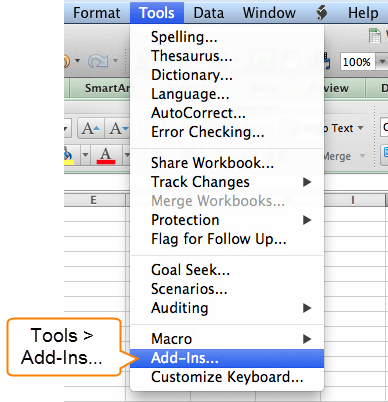
Open the Add-ins Menu in Excel. Select the Tools menu in menu bar. Select the Add-Ins option. Press the Select button in the Add-Ins window. Find the add-in file that you saved on your computer in Step 1. Then press the Open button. The add-in file should now appear in the list of available add-ins in the Add-Ins window.
Merge Add-in for Excel 2016 or higher for the Mac
Jul 05, 2016. Most Excel users don’t realize there’s a whole world of spreadsheet add-ins just itching to make their jobs — and lives — so much easier. There are add-ins to boost your productivity, and even add snazzy visualizations to make your spreadsheets stand out from the snoozefests you’re used to. Dec 09, 2019. If youre making use of Excel 2007, click on the Microsoft Office Button, and after that click Excel Options In the Manage package, select Excel Add-ins and then click Go. If youre using Excel for Mac, in the file menu proceed to Equipment Excel Add-ins. In the Add-Ins box, check out the Evaluation ToolPak check container, and then click Fine. After an admin deploys add-ins for users in an organization, the admin can turn add-ins off or on, edit, delete, and manage access to the add-ins. For more information about installing add-ins from the admin center, see Deploy add-ins in the admin center. Add-in states. Download Excel 2007 Add Ins Mac Software Advertisement Corrupt Office 2007-OO Text Extractor v.1.0 Free corrupt Word 2007 DOCX, Excel 2007 XLSX, PowerPoint 2007 PPTX, Open Office Writer, Open Office Calc & Open Office Impress data/text salvage service.
Briefly! RDBMerge is a user friendly way to Merge Data from Multiple Excel
workbooks into a Summary Workbook.
Download add-in for Excel 2016 or higher
Note: RDBMerge is available as freeware. But you can use the Contact button in the menu if you want to support the development of this merge add-in.
Mac Excel 2016 and higher
RDBMerge for Excel 2016 or higher for the Mac, version 3.0
File date : 9-Dec-2019
How to install the Add-in after you unzip it on your Mac

- Open Excel 2016 or higher
- Update Excel (See button in the Help menu)
- Use Tools>Excel Add-ins... in the menu to open the Add-ins dialog
- Use the Browse button to select the add-in and choose Open
- Press OK
- Done
Note: If you copy the Add-in in the Add-ins folder it will be automatic in your Add-ins dialog list, for finding this folder see : Setup your Mac for Mac Office 2016 or higher
Read the information below good
You can find a button named RDBMerge Add-in to open the add-in on the Data tab on the Ribbon. Important : 'Enable all macros' in Excel>Preferences>Security if you want to merge files that contain VBA code. There is a bug in Mac Excel that not trust if a installed add-in in Excel for the Mac opens other workbooks with code like this merge add-in does, and I not think you like to click on allow in the security warning dialog that pop up for every file you want to merge. Be aware that if you uncheck this checkbox that it always open files with code without a warning.
Best Excel Add Ins
Also the location of the files you want to merge is important in Excel 2016 or higher because of Apple’s sandbox requirements, read this page and use a folder in your Office folder.
How to use the RDBMerge Add-in Step by step
Folder Location:
In the folder location section click on the Browse button and select the folder with the files you want to merge. After you do that you see the path returned in the UserForm. You can also set the level of subfolders in the dropdown (max of 9)
Which Files:
In the section “Which Files” select the type of files in the dropdown that you want to merge. If you use the first option 'XL?' it will merge all type of Excel files (xls, xlsx, xlsm, xlsb). But you can also only merge files with a specific extension in the folder. By default the option to merge all files in the folder is selected but you can also use the option to filter on the file names or to select the files you want to merge.
Which worksheet(s):
In this section you have the option to choose the worksheet by index or name. If you use the index 1 it will use the first worksheet in each file, you not have to know the worksheet name this way. You can also merge data from all worksheets or use the filter option to filter on the worksheet names.
Which range:
You have the option to merge a fixed range (can be more than one area). Click on the Tips button for more information. Or use the First cell ? till last cell on worksheet option, you can change the start cell. Use A2 for example if you not want to copy your header each time.
Different options:
Before we press on the Merge button we have a few options here that you can change.
The Add file name checkbox will add the file name or file and sheet name before or above your data. You can use it for example to filter the Summary sheet for the data from a certain file.
To avoid problems with formulas I suggest you always check Paste as values.
If your workbooks have links to other workbooks use the UpdateLinks option to update the values.
Use the Paste data next to each other option if you want paste the data from each file next to each other instead of below each other. If you set your fixed range for example to A1:A100 and check this check box it will use one column for each file in the combine sheet. If your range have two columns it will use two columns for each file in the combine sheet.
If your workbooks have an Open password you can fill in the open/modify password in the two text boxes, it is no problem if there are also workbooks with no password in the folder.
Click on the Merge button:
When you click on the Merge button it will create a new workbook for you with two worksheets:
Combine Sheet with all the data
Log Sheet with copy/paste and error information
Then it is up to you if you want to save this workbook.
You see it is very easy to work with this add-in, testing all options with a few files in a test folder is the best way to get familiar with this add-in. If you have problems or have suggestions let me know and I try to help you.
If you want VBA code examples see this page : Merge Excel workbooks on a Mac
Download Excel Add Ins Macaroni
Install the Excel Data Analysis Tool Pack
Which version of Excel do you have installed on your computer?
Excel 2003 Load the Analysis Toolpak
|
Excel 2007 Load the Analysis Toolpak in Excel 2007 The Analysis ToolPak is a Microsoft Office Excel add-inprogram that is available when you install Microsoft Office or Excel. To use it in Excel, however, you need to load it first.
|
| Excel 2010 Load the Analysis Toolpak in Excel 2010 Note: it is possible that the Analysis ToolPak was loaded when you originally installed Excel. To check this see if Data Analysis is listed under the Data tab. The Analysis ToolPak is a Microsoft Office Excel add-inprogram that is available when you install Microsoft Office or Excel. To use it in Excel, however, you need to load it first.
|
| Excel for the Mac I do not use a Mac, so I'm don't know for sure how the ToolPac for the Mac works. However, here are some options you can try. (I welcome your comments about how helpful this is.)
|